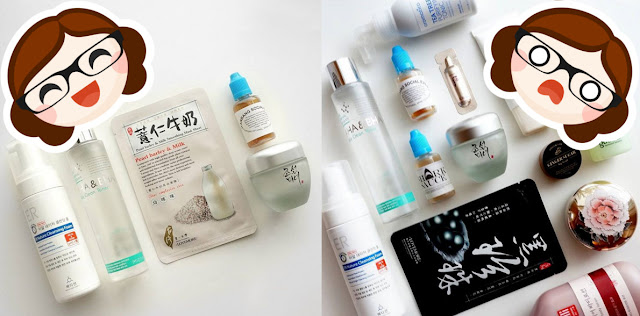
I have a confession: I've been in a bit of a skincare funk. For a long time, I've blamed it on overwork-- working 60 hours a week has left me little time for luxuries like brushing my hair showering daily sleeping more than a few hours a night an elaborate skincare routine, but I've come to realize that it's much more than that. I'm in a K-Beauty funk, meaning that I've been feeling conflicted and troubled every time I go to wash my face. It's time for some soul-searching.
As K-Beauty has become more and more mainstream in the west, it's gone from being an ignored niche interest to a widely-marketed source of $$$ from all levels of the beauty industry, shifting from hipster-y hobbyists to an oversaturation of US-based resellers cannibalizing ideas while mega retailers like Sephora and Target stock sheet masks and snail creams.
You might think this is another one of those tired tropes of aforementioned hipster grumpy over their obscure finds becoming mainstream, but nothing could be further from the truth.
Actually, I'm absolutely thrilled that K-Beauty is in such international demand that Sulwhasoo recently launched a whopping 7 shades ranging from #11 to #33, a move which completely shocked a Korean friend of mine as she pointed out that most Korean brands feature only two shades (#21 and #23) and don't address [in her opinion] the shade needs of Koreans in Korea, let alone anyone outside of Korea.
I'm quite happy that K-Beauty has grown so much in the 4 years that I've been blogging about it, because it's seen exponential growth and it's a totally different scene since the days where I had to use Google Translate to figure out what I was buying.
What troubles me is how it's being marketed, talked about, and presented.
There's nothing wrong with a little soul-searching to examine one's own motives and reasons for doing, well, anything. But more important than what I have to say about it, is what the Korean women I know have to say about it, and I'm fortunate enough to have several sources just an email away for me to ask!
As K-Beauty has become more and more mainstream in the west, it's gone from being an ignored niche interest to a widely-marketed source of $$$ from all levels of the beauty industry, shifting from hipster-y hobbyists to an oversaturation of US-based resellers cannibalizing ideas while mega retailers like Sephora and Target stock sheet masks and snail creams.
You might think this is another one of those tired tropes of aforementioned hipster grumpy over their obscure finds becoming mainstream, but nothing could be further from the truth.
Actually, I'm absolutely thrilled that K-Beauty is in such international demand that Sulwhasoo recently launched a whopping 7 shades ranging from #11 to #33, a move which completely shocked a Korean friend of mine as she pointed out that most Korean brands feature only two shades (#21 and #23) and don't address [in her opinion] the shade needs of Koreans in Korea, let alone anyone outside of Korea.
 |
| Image from Sulwhasoo's KR site |
What troubles me is how it's being marketed, talked about, and presented.
In this post:
- The trouble with K-Beauty marketing
- Why I write about K-Beauty
- 5 Korean women share their thoughts about K-Beauty on the global stage
There's nothing wrong with a little soul-searching to examine one's own motives and reasons for doing, well, anything. But more important than what I have to say about it, is what the Korean women I know have to say about it, and I'm fortunate enough to have several sources just an email away for me to ask!